
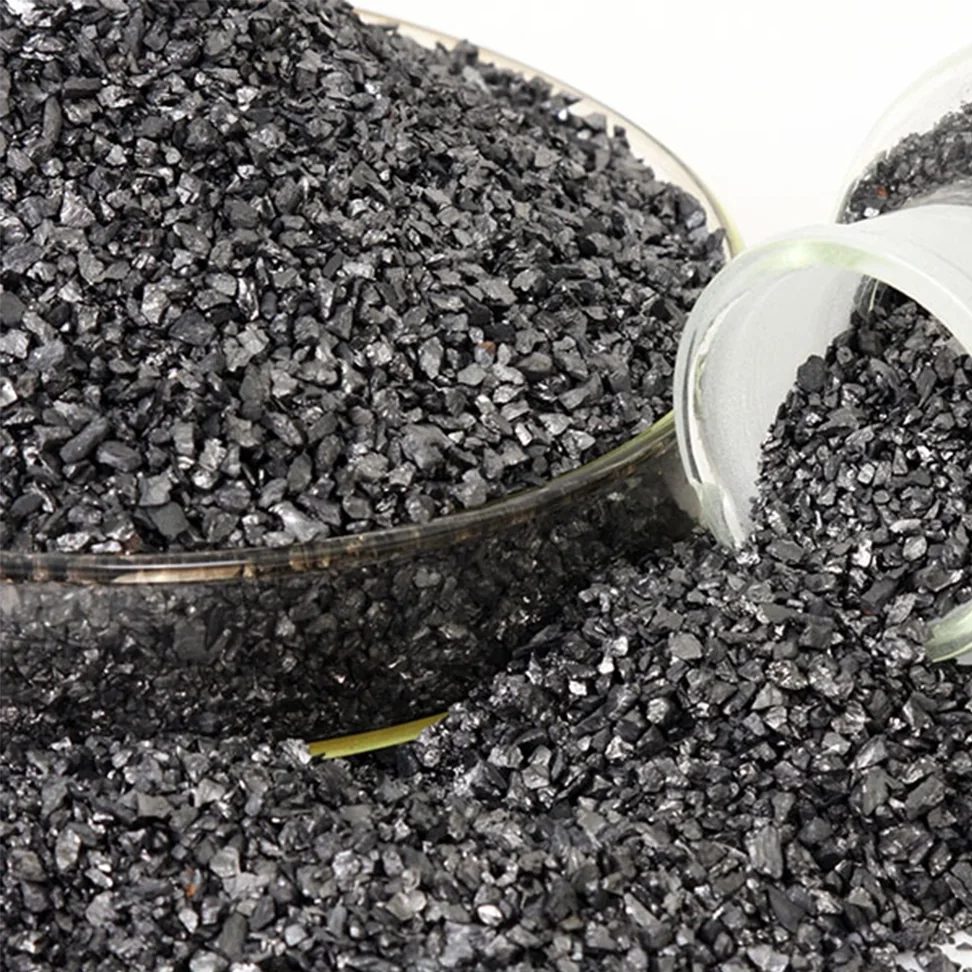
Short answer: calcined anthracite (CAC) used as a recarburizer is usually sold in fixed-carbon grades from about 90% to 95% (dry basis). As fixed carbon rises, ash falls, because on a dry basis fixed carbon, ash and volatile matter add up to 100%. Choose a grade by three numbers that matter in your melt: fixed carbon, sulfur and ash. Then pick the size fraction that suits your furnace and feeding method.
What CAC is
CAC is anthracite coal heated to drive off moisture and volatile matter, leaving a dense, carbon-rich material. Most recarburizer CAC is gas-calcined at temperatures above 1,200°C. It is the usual cost-effective carbon additive for electric arc furnace (EAF) steelmaking, ladle carbon adjustment and many foundry duties.
Electrically calcined anthracite is treated at much higher temperatures and is mainly used for carbon electrodes and cathode products, not as a standard recarburizer.
CAC grade table (Panson’s published grade limits)
| Grade | Fixed carbon, min | Ash, max | Volatile matter, max | Sulfur, max | Moisture, max |
|---|---|---|---|---|---|
| Super | 95% | 4% | 1% | 0.25% | 0.5% |
| 1st | 94% | 5% | 1% | 0.25% | 0.5% |
| 2nd | 93% | 5.5% | 1.5% | 0.30% | 0.5% |
| 3rd | 92% | 6% | 2% | 0.30% | 1% |
| 4th | 91% | 7% | 2% | 0.35% | 1% |
| 5th | 90% | 8% | 2% | 0.35% | 1% |
These are the limits listed on our CAC product page. Other suppliers label grades differently: there is no single international grade system for CAC. Compare offers by the numbers, not by grade names.
How fixed carbon, ash and volatile matter relate
On a dry basis: fixed carbon = 100% − ash − volatile matter. Two practical consequences:
- Every extra point of ash costs a point of fixed carbon. A 95% grade carries about half the mineral matter of a 90% grade, so it generates less slag for the same carbon.
- Volatile matter shows how thoroughly the material was calcined. Well-calcined CAC is typically at 1–2% or below. A lot that comes in clearly higher than the lots you accepted before deserves a question.
Real numbers: test results from two samples
In March 2023, an independent laboratory tested two Panson carbon additive samples, labelled “93%” and “95%”. The samples were submitted by Panson.
| Result (dry basis unless noted) | Sample “93%“ | Sample “95%“ |
|---|---|---|
| Fixed carbon | 94.26% | 95.57% |
| Ash | 5.14% | 3.51% |
| Volatile matter | 0.60% | 0.92% |
| Total sulfur | 0.18% | 0.16% |
| Moisture (air-dried) | 0.04% | 0.03% |
| Share within 1–5 mm (round-hole sieve) | 86.2% | 91.5% |
Checked against the grade table above:
- The “95%” sample met every Super-grade limit.
- The “93%” sample met every 2nd-grade limit. Its fixed carbon also reached the 1st-grade minimum, but its ash (5.14%) was just above the 1st-grade maximum of 5%.
That is why a grade is decided by all of its limits, not by fixed carbon alone. A report on submitted samples is a useful reference point, not a guarantee for every lot, so ask for a COA with each shipment. How to read a carbon additive COA works through this report line by line.
Sulfur: inherited from the raw anthracite
Calcination removes some sulfur, but most of the sulfur in CAC comes from the raw anthracite. That is why the anthracite source matters. Ningxia’s Taixi anthracite is often cited for comparatively low ash, sulfur and phosphorus. Even so, decide on the lot COA, not on the origin name.
For ductile iron and other sulfur-sensitive work, CAC may be too high in sulfur. GPC vs CPC vs CAC compares the options.
Size fractions by furnace and feeding method
| Size | Typical use |
|---|---|
| 0–1 mm | Injection or fine addition |
| 1–3 mm | Induction furnaces, where fast dissolution matters |
| 3–5 mm | Common bath addition |
| 5–8 mm or 5–10 mm | Larger furnaces or slower addition |
Material that is too fine is lost as dust or floats on the slag; material that is too coarse dissolves slowly. Specify the range and the percentage that must fall within it, as in the test example above.
Acceptance checklist
- The COA matches your purchase-order limits for fixed carbon, ash, volatile matter, sulfur and moisture.
- The basis (dry or as-received) on the COA matches the basis in your contract and invoice.
- Dry-basis fixed carbon, ash and volatile matter add up to about 100%.
- Particle size, and the percentage within range, fits your feeding equipment.
- The lot number and date on the COA match the shipment. For critical orders, agree on inspection at loading.
Frequently asked questions
Which CAC grade do I need?
For EAF steelmaking and gray iron, 92–95% fixed carbon is a common range. If slag volume or sulfur is tight, move up the grade table. If sulfur must be very low, consider graphitized petroleum coke instead.
Why does a 95% grade cost more than a 90% grade?
It needs cleaner raw anthracite and tighter control. You also get more carbon per tonne, so compare price per kilogram of usable carbon rather than price per tonne.
Can CAC be used in ductile iron?
It can be, where the sulfur budget allows. Many ductile iron foundries prefer GPC because it brings less sulfur and nitrogen.
What size should I order for an induction furnace?
1–3 mm is a common choice because it dissolves quickly. Match the size to how and when you add the carbon.