
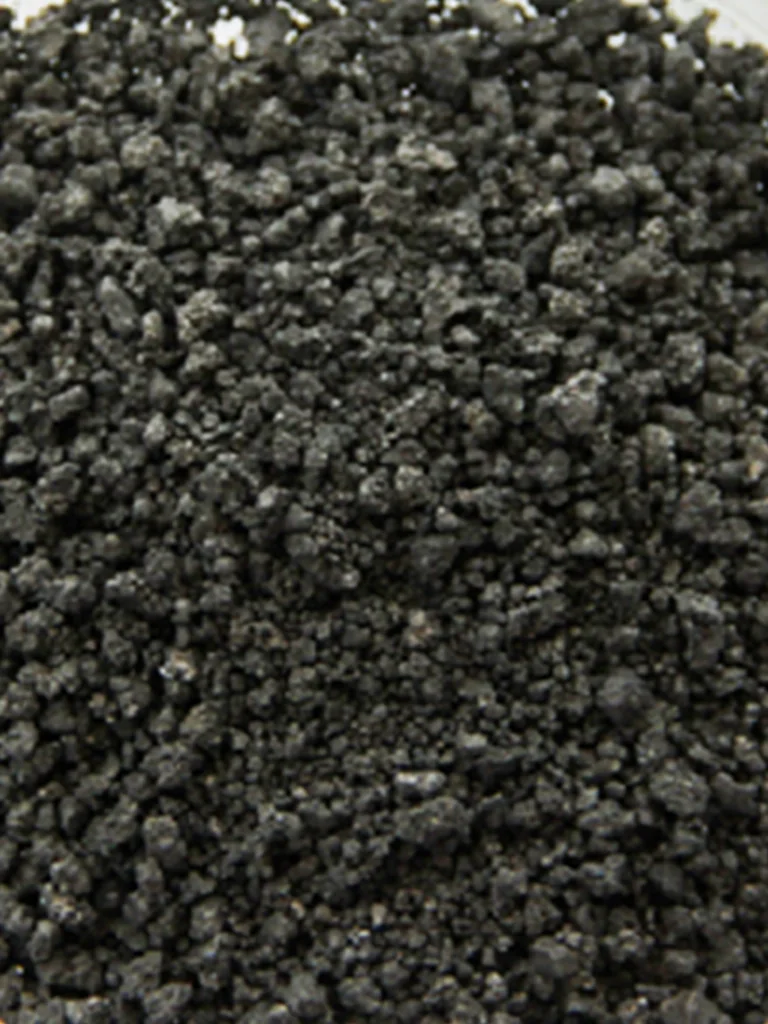
Short answer:
- CAC usually gives the lowest cost per kilogram of carbon, which makes it the standard choice for EAF steel, ladle carbon adjustment and most gray iron.
- GPC brings the least sulfur and nitrogen and dissolves readily, which makes it the usual choice for ductile iron and sulfur-sensitive grades.
- CPC sits in between: high fixed carbon at a lower price than GPC, with sulfur that depends on the petroleum coke it was made from.
The three materials in numbers
| CAC (calcined anthracite) | CPC (calcined petroleum coke) | GPC (graphitized petroleum coke) | |
|---|---|---|---|
| Raw material | Anthracite coal | Green petroleum coke | Petroleum coke |
| Heat treatment | Gas calcination above 1,200°C | Calcination at about 1,200–1,400°C | Graphitization at about 2,500–3,000°C |
| Carbon structure | Dense, mostly non-graphitic | Non-graphitic | Ordered, graphitic |
| Fixed carbon | 90–95% | 98–98.5% | 98–99% |
| Ash, max | 4–8% | 0.8–1% | 0.5–1% |
| Volatile matter, max | 1–2% | 0.8–1% | 0.5–1% |
| Sulfur, max | 0.25–0.35% | 0.2–0.5% | 0.03–0.05% (0.3% for semi-GPC) |
| Nitrogen | Not always reported; ask if you track it | Retains nitrogen from the coke; ask for data | Mostly driven off by graphitization |
| Relative price per tonne | Lowest | Middle | Highest |
The fixed carbon, ash, volatile matter and sulfur ranges are the limits of Panson’s published grades on the CAC, CPC and GPC pages. Other suppliers’ grades differ, and the lot COA is what counts. For a worked example of real test results, see How to read a carbon additive COA.
Which one fits your melting route
| Route or product | Usual first choice | Why |
|---|---|---|
| EAF steelmaking, ladle carbon adjustment | CAC | Lowest cost per kg of carbon; sulfur is usually within limits |
| Induction furnace, gray iron | CAC (1–3 mm) or CPC | Fine CAC dissolves quickly enough; CPC when ash must be lower |
| Ductile (nodular) iron | GPC | Low sulfur saves magnesium and protects nodularity; low nitrogen reduces pinhole risk |
| Low-sulfur steel grades | GPC or low-sulfur CPC | Sulfur pickup must stay minimal |
| Tight budget, moderate sulfur limit | Low-sulfur CPC or semi-GPC | High fixed carbon without the full graphitization premium |
Compare cost per kilogram of carbon, not price per tonne
Cost per kg of carbon recovered = price per tonne ÷ (1,000 × fixed carbon × recovery rate)
The recovery rate is the share of added carbon that ends up dissolved in the melt. It depends on the material, the size, the furnace and how the carbon is added, so use your own plant data.
Illustration (hypothetical numbers, not quotations):
- Material A costs 400 per tonne, with 94% fixed carbon and 85% recovery: 400 ÷ (1,000 × 0.94 × 0.85) = 0.50 per kg of carbon.
- Material B costs 800 per tonne, with 98.5% fixed carbon and 95% recovery: 800 ÷ (1,000 × 0.985 × 0.95) = 0.85 per kg of carbon.
Material B costs about 70% more per kilogram of carbon. It pays off only if its lower sulfur or nitrogen saves more elsewhere: less magnesium treatment, fewer rejected castings, or a steel grade you could not otherwise make.
How to test a switch
- Agree on the grade, size and limits with the supplier, and get the lot COA.
- Run several heats while holding the charge mix and practice constant.
- Record carbon pickup, final sulfur (and nitrogen if tracked), slag and defect rates.
- Recalculate the cost per kilogram of carbon with your measured recovery.
Frequently asked questions
Can I replace GPC with CAC to cut cost?
Only if your sulfur and nitrogen budget allows. CAC adds more sulfur per kilogram of carbon. In ductile iron, that means more magnesium consumption and a higher risk to nodularity. Trial it before switching.
What is semi-GPC?
Petroleum coke that is only partly graphitized. In Panson’s grade table it has at least 98% fixed carbon and up to 0.3% sulfur. That puts it between CPC and full GPC.
Why does GPC dissolve faster?
Graphitization reorganizes the carbon toward an ordered graphite structure, which dissolves more readily in liquid iron than non-graphitic carbon. That shortens holding time, especially in induction furnaces.
Which has the lowest sulfur?
GPC. Panson’s standard grade allows up to 0.05% sulfur, and the premium grade up to 0.03%. Graphitization at about 2,500°C and above drives most sulfur and nitrogen out.
Does CPC contain nitrogen?
Yes. Calcination removes volatile matter but leaves much of the coke’s nitrogen. If your castings are prone to pinholes, ask for nitrogen data or choose GPC.